At work I was surfing through the Google to find what the studies of spinal cord have been conduct so far. I’ll be honest, something so specific is quite difficult to find, because pops up a lot of unnecessary information. As soon as you get to it, which might be useful, it requires from you money for viewing the research and supplements you still don’t know whether will this information be really useful or can be trusted. By this delving I detect a number of studies, where at the nerve endings of human added to devices, which gives the electrical impulses and thereby stimulates contraction of the muscle. The result’s, by pressing a button human can move the leg. This research amused me, because it’s obvious – if you add the nerves to electricity than influenced by reflex of the muscle it will contract. Even if a human will success to add the power cord of each muscle and to develop software, which could imitate the movement of human, I doubt whether it would be possible that he will start to walk thereafter. I consider that to enable qualitative body moves, there must be the senses how accurately you put the foot, how far and at what moment a knee or hip have to serve. That was the first idea, is it possible to create special device which would be able to understand the sensory nerves.
Short and simple lecture in anatomy.
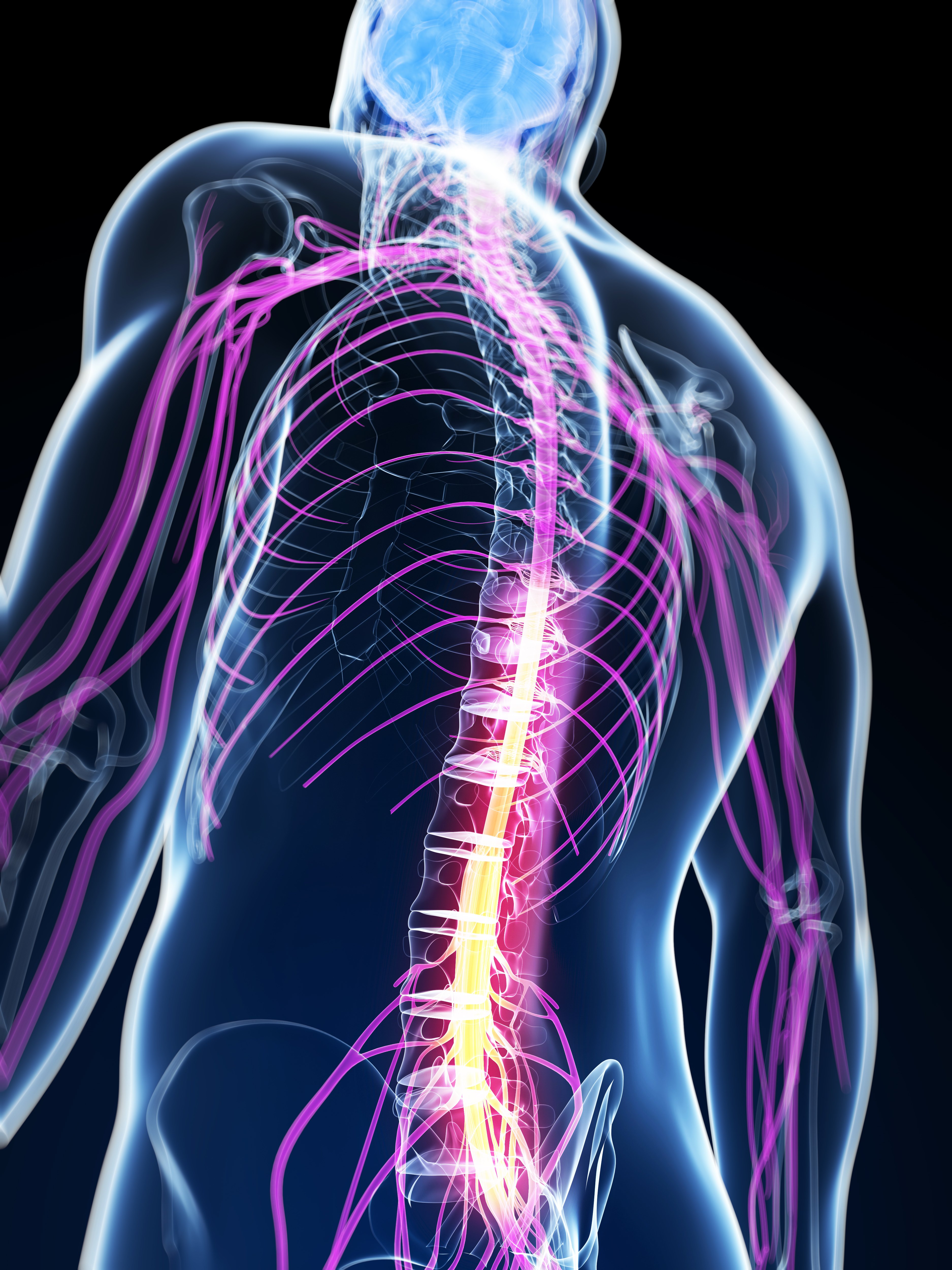
The spinal cord runs through in the middle of entire backbone. The backbone consists of vertebrae, between the vertebrae are gaps through these gaps from the spinal cord go out nerves. There are two types of nerves – sensory nerves and motor nerves. Example of spinal cord operation – we touch something sharp-cut with a finger, than through the sensory nerves this signal of pain goes to the spinal cord and further to the brain. The brain processes the information, decides what to do and sends a signal through the motor nerves to the muscle and human remove the finger of sharpness. If the spinal cord is injured, sensory and motor nerves are unable to transmit the information through the damaged area. All organs are operating, only the exchange of information is stopped. As a result, human has no senses and there is no possibility to move the limbs below the damaged area.
The idea was to invent a device, which can be connected to sensory nerves below the damaged area. Explore the signals and how they differ depending on the location of the body, and the strength of which they are stimulated. To convert these signals, in already known to us, electrical and then by making reverse of the operation to connect above the damaged area to the spinal cord, thereby to restore the flow of information between the both parties.
I wrote my idea on the paper and decided to find any expert who could confirm my theory, or wholly contrary, substantiate what the difficulties would be to introduce it in life. Therefore I contacted with director of Electronics and Computer Engineering Institute of Latvia Modris Greitāns and arranged a meeting with him.

 dzirkalis